Showing posts with label DWH MODELING. Show all posts

Tuesday, 24 June 2014

Type of Data Modeling?

Type of Data Modeling?

1) Conceptual Data Model
2) Logical Data Model
3) Physical Data Model

Conceptual Data Model - Design Step 1

This is First step for DWH Designing.

Conceptual Data Model is the first step in Data Warehouse design. In conceptual data model, very high level relationships between dimension and fact table is depicted. Conceptual data model not necessarily includes keys, attributes of tables. Conceptual data model gives a very high level idea of proposed Data Warehouse design including possible fact and dimension table. Conceptual data model is the stepping stone to design logical data model of Data Warehouse.


Characteristics of Data Warehouse Conceptual Data Model
  1. It shows only high level relationship between tables.
  2. It does not show primary key or column names
  3. It is the stepping stone of Logical Data Model

Logical Data Model - Design Step -2

This is Second step for Designing  

Good Logical data model in data warehouse implementation is very important. Logical data model has to be detailed (though some might not agree) as it represents the entire business in one shot and shows relationship between business entities. Logical Model should have following things to make it detailed and self explanatory.
  1. All entities to be included in data warehouse
  2. All possible attributes of each entity
  3. Primary keys of each entity ( Natural Keys as well as Surrogate Keys )
  4. Relationships between each every entity
Characteristics of Data Warehouse Logical Data Model
  1. It has all the entities which will be used in data warehouse
  2. It shows all possible attributes of all entities
  3. It depicts the relationships between all entities

Physical Data Model - Design Step -3

This is third step for Designing for DWH Design

Physical Data Model is the actual model which will be created in the database to store the data. It is the most detailed data model in Data Warehouse data modeling. It includes
  1. Tables names
  2. All column names of the table along with data type and size
  3. Primary keys, Foreign Keys of a table
  4. Constraints

Physical Data Model can be converted to actual SQL DDL statement by using different tools. ERWIN is the famous tool to do this.

Tuesday, 16 April 2013

CA ErWin Data Modeler History

CA ErWin Data Modeler
Computer Associates' ErWin data modeler is an industry leading modeling tool that provides features to create, maintain databases and data warehouses. ErWin provides a very user friendly GUI, that enables data modelers define, organize and modify data structures very easily.
History
  • ErWin was first developed by Logic Works Inc.
  • Logic Works was then acquired by Platinum Technologies Inc. in 1998
  • Later in 1999 Computer Associates acquired Platinum Technologies and added ErWin to their AllFusion Suite under the name AllFusion ErWin Data Modeler

Data Modeling Tools

 Data Modeling Tools


Tool Name Company Name
Erwin Computer Associates
Embarcadero Embarcadero Technologies
Rational Rose IBM Corporation
Power Designer Sybase Corporation
Oracle Designer Oracle Corporation
Xcase RESolution LTD.

Thursday, 28 March 2013

What is Fact ? and Types of Fact?


Types Dimensions in Dimensional Modeling


Difference between Datamart and Data Warehouse

What is Factless Fact table? When we will use this?

Dimensional Hierarchy example

Dimensional Hierarchy example  Data Warehouse Concepts


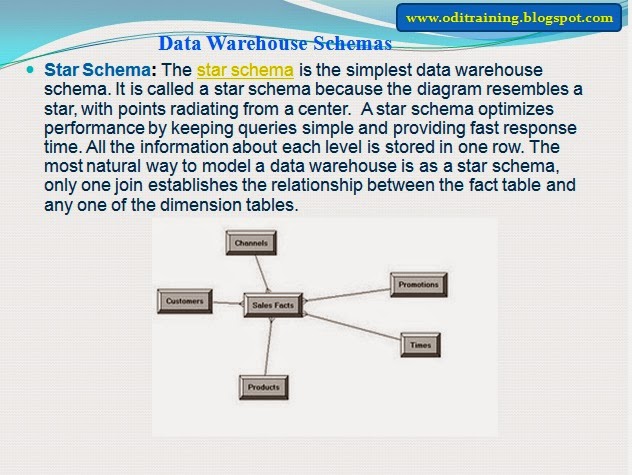
Start Schema Data Warehouse Concepts

Start   Schema Data Warehouse Concepts


Snowflake Schema Data Warehouse Concepts

Snowflake Schema Data Warehouse Concepts

Galaxy Schema Data Warehouse Concepts

Galaxy Schema Data Warehouse Concepts


Differences between Star Schema and Snowflake Schema Data Warehouse Concepts

Differences between Star Schema and Snowflake Schema Data Warehouse Concepts


SCD - Slowly Changing Dimention - Type 1, Type -2 , Type -3 Data Warehouse Concepts


SCD - Slowly Changing Dimention - Type 1, Type -2 , Type -3 Data Warehouse Concepts


If you are using This at ODI we have separate IKM for SCD type -2

Oracle IKM Slowly Changing Dimensions

And Below Properties we need to set for each column.

DataStore=>OLAP Type=> Slowly Changing Dimension.

1) Surrogate Key or Natual Key
2) Overwrite on Change ( No History)
3) Add row on change ( With History as a new record)
4) Starting Timestamp ( Record starting date)
5) Ending Timestamp ( Record Ending date lifetime)
6) Record status flag  ( Records status Active or Inactive (1-Active, 0-Inactive)


Top-down versus bottom-up design methodologies in Datawarehousing


Bottom-up design

Ralph Kimball, a well-known author on data warehousing, is a proponent of an approach to data warehouse design which he describes as bottom-up.
In the bottom-up approach, data marts are first created to provide reporting and analytical capabilities for specific business processes. It is important to note that in Kimball methodology, the bottom-up process is the result of an initial business-oriented top-down analysis of the relevant business processes to be modelled.
Data marts contain, primarily, dimensions and facts. Facts can contain either atomic data and, if necessary, summarized data. The single data mart often models a specific business area such as "Sales" or "Production." These data marts can eventually be integrated to create a comprehensive data warehouse. The integration of data marts is managed through the implementation of what Kimball calls "a data warehouse bus architecture" The data warehouse bus architecture is primarily an implementation of "the bus", a collection of conformed dimensions and conformed facts, which are dimensions that are shared (in a specific way) between facts in two or more data marts.
The integration of the data marts in the data warehouse is centered on the conformed dimensions (residing in "the bus") that define the possible integration "points" between data marts. The actual integration of two or more data marts is then done by a process known as "Drill across". A drill-across works by grouping (summarizing) the data along the keys of the (shared) conformed dimensions of each fact participating in the "drill across" followed by a join on the keys of these grouped (summarized) facts.
Maintaining tight management over the data warehouse bus architecture is fundamental to maintaining the integrity of the data warehouse. The most important management task is making sure dimensions among data marts are consistent. In Kimball's words, this means that the dimensions "conform".
Some consider it an advantage of the Kimball method, that the data warehouse ends up being "segmented" into a number of logically self-contained (up to and including The Bus) and consistent data marts, rather than a big and often complex centralized model. Business value can be returned as quickly as the first data marts can be created, and the method gives itself well to an exploratory and iterative approach to building data warehouses. For example, the data warehousing effort might start in the "Sales" department, by building a Sales-data mart. Upon completion of the Sales-data mart, the business might then decide to expand the warehousing activities into the, say, "Production department" resulting in a Production data mart. The requirement for the Sales data mart and the Production data mart to be integrable, is that they share the same "Bus", that will be, that the data warehousing team has made the effort to identify and implement the conformed dimensions in the bus, and that the individual data marts links that information from the bus. Note that this does not require 100% awareness from the onset of the data warehousing effort, no master plan is required upfront. The Sales-data mart is good as it is (assuming that the bus is complete) and the Production-data mart can be constructed virtually independent of the Sales-data mart (but not independent of the Bus).
If integration via the bus is achieved, the data warehouse, through its two data marts, will not only be able to deliver the specific information that the individual data marts are designed to do, in this example either "Sales" or "Production" information, but can deliver integrated Sales-Production information, which, often, is of critical business value.


Top-down design

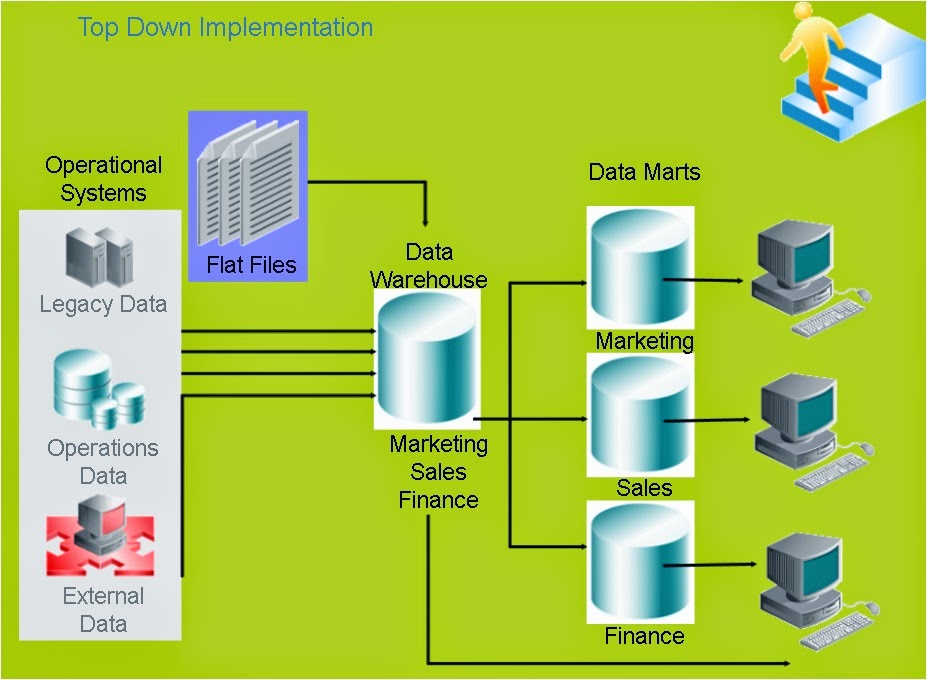
Bill Inmon, one of the first authors on the subject of data warehousing, has defined a data warehouse as a centralized repository for the entire enterprise. Inmon is one of the leading proponents of the top-down approach to data warehouse design, in which the data warehouse is designed using a normalized enterprise data model. "Atomic" data, that is, data at the lowest level of detail, are stored in the data warehouse. Dimensional data marts containing data needed for specific business processes or specific departments are created from the data warehouse. In the Inmon vision, the data warehouse is at the center of the "Corporate Information Factory" (CIF), which provides a logical framework for delivering business intelligence (BI) and business management capabilities.
Inmon states that the data warehouse is:
Subject-oriented
The data in the data warehouse is organized so that all the data elements relating to the same real-world event or object are linked together.
Non-volatile
Data in the data warehouse are never over-written or deleted — once committed, the data are static, read-only, and retained for future reporting.
Integrated
The data warehouse contains data from most or all of an organization's operational systems and these data are made consistent.
Time-variant
For An operational system, the stored data contains the current value.
The top-down design methodology generates highly consistent dimensional views of data across data marts since all data marts are loaded from the centralized repository. Top-down design has also proven to be robust against business changes. Generating new dimensional data marts against the data stored in the data warehouse is a relatively simple task. The main disadvantage to the top-down methodology is that it represents a very large project with a very broad scope. The up-front cost for implementing a data warehouse using the top-down methodology is significant, and the duration of time from the start of project to the point that end users experience initial benefits can be substantial. In addition, the top-down methodology can be inflexible and unresponsive to changing departmental needs during the implementation phases.


Hybrid design

Data warehouse (DW) solutions often resemble the hub and spokes architecture. Legacy systems feeding the DW/BI solution often include customer relationship management (CRM) and enterprise resource planning solutions (ERP), generating large amounts of data. To consolidate these various data models, and facilitate the extract transform load (ETL) process, DW solutions often make use of an operational data store (ODS). The information from the ODS is then parsed into the actual DW. To reduce data redundancy, larger systems will often store the data in a normalized way. Data marts for specific reports can then be built on top of the DW solution.
It is important to note that the DW database in a hybrid solution is kept on third normal form to eliminate data redundancy. A normal relational database however, is not efficient for business intelligence reports where dimensional modelling is prevalent. Small data marts can shop for data from the consolidated warehouse and use the filtered, specific data for the fact tables and dimensions required. The DW effectively provides a single source of information from which the data marts can read, creating a highly flexible solution from a BI point of view. The hybrid architecture allows a DW to be replaced with a master data management solution where operational, not static information could reside.
The Data Vault Modeling components follow hub and spokes architecture. This modeling style is a hybrid design, consisting of the best practices from both 3rd normal form and star schema. The Data Vault model is not a true 3rd normal form, and breaks some of the rules that 3NF dictates be followed. It is however, a top-down architecture with a bottom up design. The Data Vault model is geared to be strictly a data warehouse. It is not geared to be end-user accessible, which when built, still requires the use of a data mart or star schema based release area for business purposes.


Physical Data Model - Design Step -3

This is third step for Designing for DWH Design 

Physical Data Model is the actual model which will be created in the database to store the data. It is the most detailed data model in Data Warehouse data modeling. It includes
  1. Tables names
  2. All column names of the table along with data type and size
  3. Primary keys, Foreign Keys of a table
  4. Constraints

Physical Data Model can be converted to actual SQL DDL statement by using different tools. ERWIN is the famous tool to do this.

Logical Data Model - Design Step -2

This is Second step for Designing 

Good Logical data model in data warehouse implementation is very important. Logical data model has to be detailed (though some might not agree) as it represents the entire business in one shot and shows relationship between business entities. Logical Model should have following things to make it detailed and self explanatory.
  1. All entities to be included in data warehouse
  2. All possible attributes of each entity
  3. Primary keys of each entity ( Natural Keys as well as Surrogate Keys )
  4. Relationships between each every entity
Characteristics of Data Warehouse Logical Data Model
  1. It has all the entities which will be used in data warehouse
  2. It shows all possible attributes of all entities
  3. It depicts the relationships between all entities

Conceptual Data Model - Design Step 1

This is First step for DWH Designing.

Conceptual Data Model is the first step in Data Warehouse design. In conceptual data model, very high level relationships between dimension and fact table is depicted. Conceptual data model not necessarily includes keys, attributes of tables. Conceptual data model gives a very high level idea of proposed Data Warehouse design including possible fact and dimension table. Conceptual data model is the stepping stone to design logical data model of Data Warehouse.


Characteristics of Data Warehouse Conceptual Data Model
  1. It shows only high level relationship between tables.
  2. It does not show primary key or column names
  3. It is the stepping stone of Logical Data Model